
Journal · Jeddah
Give Jeddah the evening, and only one of them.
Al-Balad first, while you can still walk. The Corniche after, for the light and the meal. Refuse the second idea that sounds equally good.
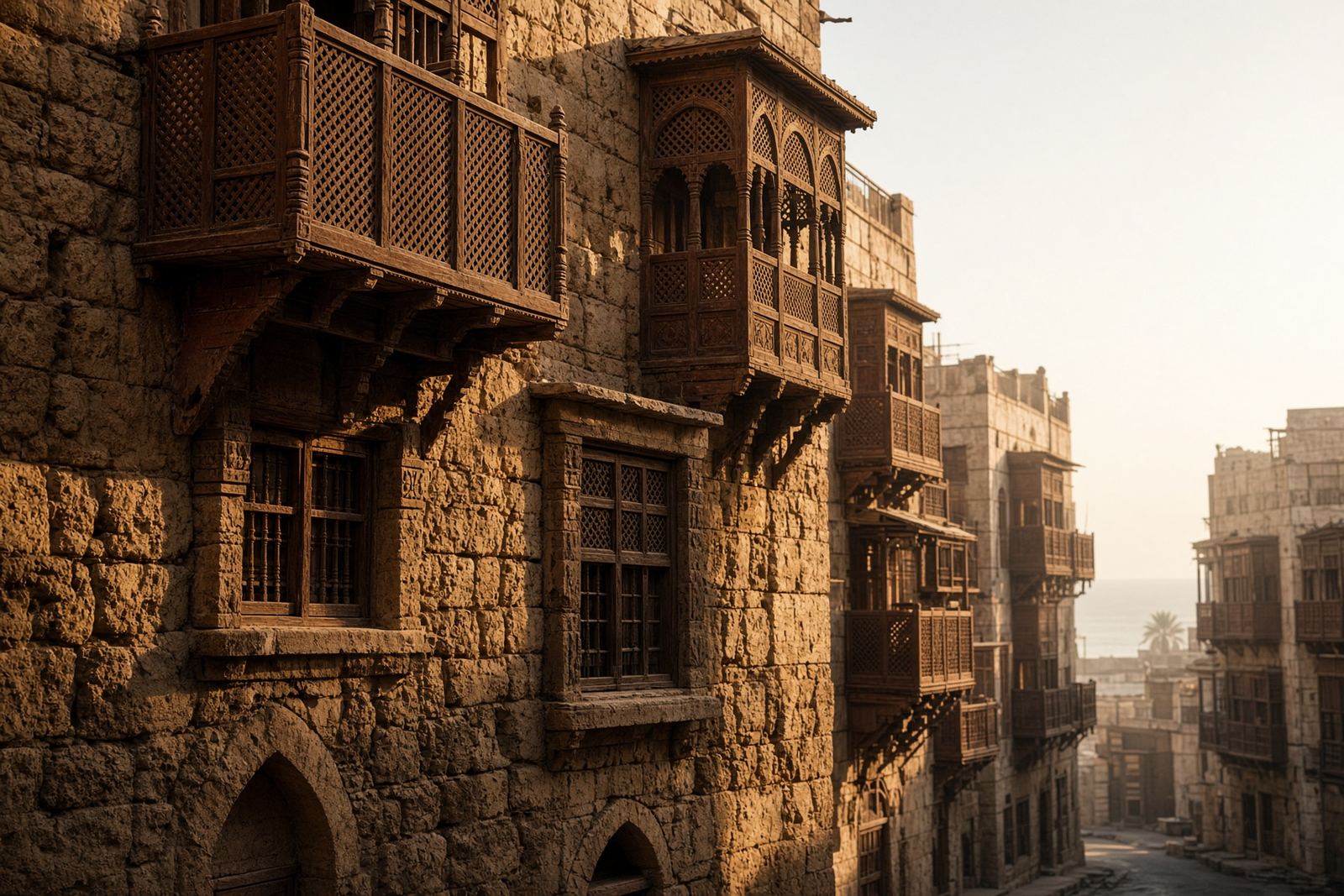
Jeddah is a port that learned to be a city, not a skyline that happens to have water. People with one evening try to prove they understand both. They land, they open a map, and they draw a line through the old town, the Corniche, a fountain, a mall, and Makkah, because Makkah looks close. By nine they have seen a blur of coral and they are cross with the humidity. The city did not fail. The line did.
Pick a sequence and refuse the second idea. The sequence that works, if you still have your legs, is Al-Balad and then the water. Not the other way round if you can help it. Old stone is a poor last stop. Tired people skip the thing they flew for and keep the sea, because the sea asks less.
Al-Balad while you are still willing
Start in Al-Balad. The coral houses and the wooden rawasheen, those projecting lattice balconies, are why the quarter is on the UNESCO list. They were a merchant city before they were a photograph: shade, a breeze off the sea, a way to see the lane without sitting in it. Walk the lanes you are meant to walk. The point is the shade, the wood, and a street that still has a job, not a courtyard that has been lit for a video.
Do this before you are tired
If the flight gives you late afternoon, go straight there. Do not “drop the bags and rest for an hour” if that hour becomes the hour the light goes and you decide the old town can wait. It can wait. You will not be in the mood when it does. Midday in the hot months, trying to do Al-Balad quickly, is how the coral streets become a headache. The season note puts the kind window at November to March. Outside it, the evening still works. The march at one o’clock does not.
If you land late
Eat first. Then walk the lanes while they are still lit. Take the Corniche afterwards as a short sit, not as a march you owe the sea. Lit stone is enough. You do not need to cover the quarter. You need one street you actually looked at, and the sense to leave before you are counting doorways.
- Al-Balad before you are tired, not after the sea has already won.
- Lanes, shade, balconies. Not a list of courtyards.
- November to March if you want the walk to feel like a walk.
- In the hot months, shorter, later, and no heroics at noon.
Then the water, and stop adding
The Corniche is the exhale. Stay long enough to see the light go, then eat. You do not need a second viewpoint. The Red Sea is the viewpoint. Sit where you can hear it, not where a screen is louder. If a fountain is on the way and you like fountains, fine. If it is a detour that makes you late for a table, it is not fine. One evening has room for a sit. It does not have room for a tour of every thing Jeddah has lit up since 2010.
What to eat, if you want the city and not a buffet
Hijazi food here is not a performance of kabsa for a hotel. Saleeg is the comfort plate: rice cooked down with milk, usually beside chicken. Mutabbaq is the thin crisp fold you eat with your hands, savoury or sweet, and it should crackle, not taste like a reheated wrap. A room that was already full will tell you more than a third viewpoint and a menu in three languages. The longer version of that test is the table note. Use it. If you are exhausted, a simple plate is still more honest than a buffet that has flattened the coast into orange rice.
Clothes and the walk
The evening is warmer and damper than Riyadh people expect, and it is still not a beach walk in beach clothes through Al-Balad. Cover what the lanes are covering. Save anything looser for a private pool, if you have one, not for the coral streets. Humidity is not an excuse. It is the climate. Cotton you can walk in, shoes that can take an uneven lane, and a layer if the Corniche wind turns after dark. That is the bag.
The idea to refuse
Makkah. It sits near Jeddah on every map a visitor opens, and it is not an add-on to this evening. The two cities are close in kilometres and far in a queue, in traffic, and in what the night is for. Do not stack it unless someone who lives on that road is driving, and even then ask them if they mean it or if they are being polite. A polite yes ruins three people’s sleep.
The same refusal applies to “a quick look at the new waterfront and then Al-Balad and then dinner in a third district.” Pick the old town and the water. If you already know Al-Balad well, then you are not the reader this page is for, and you can spend the evening on the Corniche without guilt. First-timers who skip the coral houses because a skyline looked easier will feel, on the plane home, that they missed the city. They will be right.
- No Makkah on this same night.
- No third district.
- No mall, unless you need medicine. A mall is not Jeddah. It is a mall.
- If the children are finished, sit. Do not buy one more stop to justify the taxi.
A sequence you can actually keep
When you have the late afternoon
Hotel or friend’s house, bags down, straight to Al-Balad. An hour in the lanes is enough if it is a real hour. Then the Corniche while the light goes. Then a table, Hijazi if the room is full, anything honest if it is not. Then stop. The city at night from a moving car is a bonus, not a plan. You are allowed to be back before midnight and still have done Jeddah.
When the flight is late
Eat near where you are sleeping if you are frayed. Then the lit lanes, a shorter loop than you saved on your phone. Corniche only if the sit will be a sit. If it will be another march, skip it and look at the water in the morning for ten minutes before the airport. Ten honest minutes beat a sullen hour.
When you are only changing planes
Do not do this. A layover is not an evening, and Al-Balad does not deserve to be squeezed between two boarding calls. Stay at the airport, or leave the city for a day when you can miss a flight without it being a crisis. I know that is dull advice. Dull is why people make the other mistake.
What the evening feels like if you let it
Jeddah is louder, damper, and more mixed than the capital’s Friday quiet. You will hear more languages in one lane than in a Riyadh ministry. The old houses lean. Some are restored and some are still deciding. Both are allowed to be in the same street. You do not have to narrate which is which. Walk, look up at the wood, accept a coffee if it is offered in a place that already had customers, and then go and sit where the sea air can reach you. That is a complete evening. Adding to it is how it becomes a schedule.
Conclusion
One evening in Jeddah is Al-Balad first and the Corniche after. Walk the coral and the rawasheen while you still can, then let the water finish the day, and eat in a room that was already full. November to March is when the walk is kind. In the heat, shorten it. Do not add Makkah, a mall, or a third district. Refuse the second good idea. The first one was enough.
Questions people actually ask
What should I do with one evening in Jeddah?
Al-Balad, then the Corniche, then a meal. Start with the old town so you do not spend your energy on the easy part and skip the reason the quarter is famous. If you land late, eat, walk the lit lanes, and keep the sea short.
When is Jeddah pleasant to walk?
November to March. Outside those months the evening can still be good, especially by the water, but do not try to cover Al-Balad at midday in summer. Humidity is the price even in the kind months. Dress for a city evening, not for a pool.
Can I see Makkah the same night?
Not as an extra. The map is a liar about time. Unless a person who drives that road for a living is taking you, and they have said the night can hold it, leave Makkah for a day that is about Makkah. This evening is about Jeddah.
Related notes
Updated 21 October 2026. KSA GUIDE is independent and based in Riyadh. We do not book Jeddah and we do not run tours.